How to See the ISS Tonight, Step by Step
When Can You See the ISS? explains why passes happen when they do: the Station shines by reflected sunlight, so you only see it when your sky is dark and it’s still lit, which happens in the hours around dusk and dawn. This note is about finding tonight’s pass and catching it.
Step 1: find out whether there’s a pass tonight
The ISS goes over most of the US several times a day, but only some of those passes are visible, and the visible ones come in runs. NASA says you might get one chance a month or several a week, depending on the season and where you live. So the first job is checking the schedule.
The official source is NASA’s Spot the Station, which is now an app for iPhone and Android. NASA shut down the old website lookup and its email and text alerts in June 2025, so any article that sends you to a web form is out of date. Give the app your location and it lists the coming passes and sends a notification before each one; you set how far ahead in its settings.
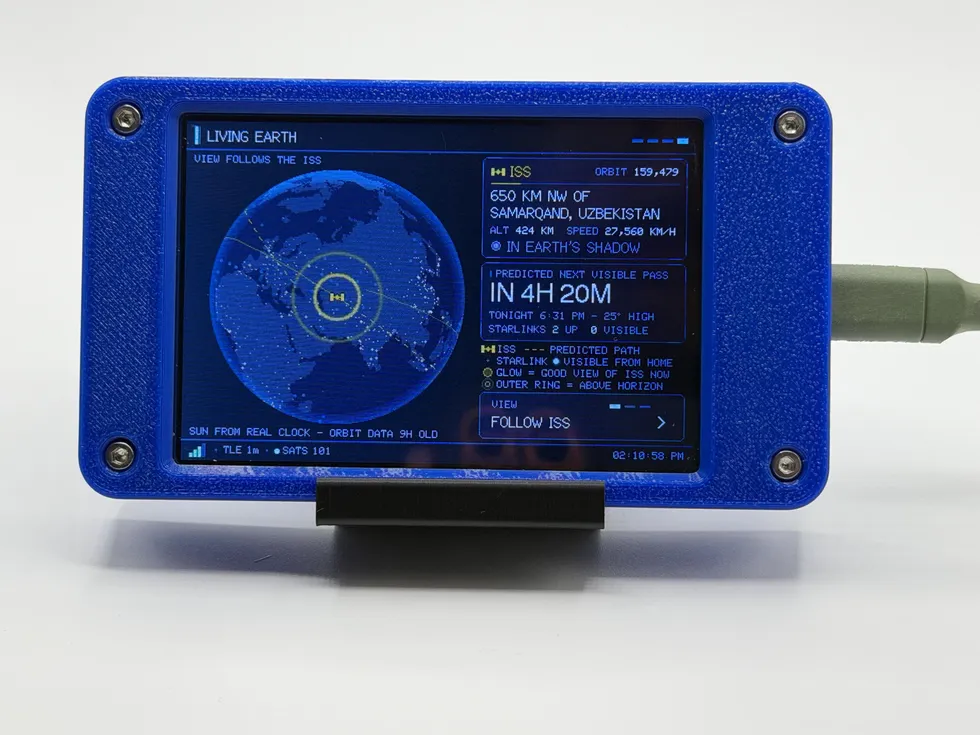
Astronomy sites such as Heavens-Above publish the same kind of predictions, and a desktop ISS tracker does the math itself and counts down on its screen.
Step 2: read the listing
A sighting listing gives you five pieces of information:
- Time: when the sighting starts, in your local time. Be outside a couple of minutes before it.
- Above the Horizon (older listings say Visible): how many minutes you’ll see it. A good pass lasts about four minutes. Short ones often end early, because the Station slides into Earth’s shadow before it reaches the horizon.
- Maximum Height: how high it climbs, in degrees, from the horizon at 0 to straight overhead at 90.
- Appears: the direction and height where it first shows up.
- Disappears: where it sets or fades out.
My rule of thumb: a maximum height of 40 degrees or more is worth a trip outside, and below about 20, buildings and trees usually get it first. If you have a choice of passes, pick the highest one. It’ll be brighter and last longer, and more of the neighborhood will be out of the way.
Step 3: turn degrees into something you can point at
Compass directions are easy with a phone. Degrees above the horizon are harder until you use your hand. NASA’s skywatching page gives the measures: held at arm’s length, your little finger covers about 1 degree of sky, your three middle fingers about 5, and a closed fist about 10.
So “appears 15 degrees above the northwest horizon” means face northwest and look a fist and a half up. A max height of 60 degrees is six fists, most of the way to overhead.
Step 4: know what you’re looking for
Go out early, give your eyes a minute to adjust, and face the direction where the Station appears. You’re looking for a bright, steady point of light moving smoothly and quickly, with no blinking and no change of direction. On a good pass it’s brighter than any star. It takes a few minutes to cross the sky, and then it either sets or fades out partway across as it flies into Earth’s shadow.
You don’t need a telescope or binoculars, and city lights don’t hide it.
Is it the ISS?
These get mistaken for it:
- A plane has blinking or colored lights and can turn. The ISS has no lights you can see and flies a straight line.
- A single satellite looks like the ISS’s dimmer cousin: steady and smooth, but much fainter. Plenty cross the sky on any dark night.
- A Starlink train is a line of evenly spaced dots moving together, usually seen in the days after a launch. The ISS is a single point, brighter than any of them.
Taking a picture
A phone can catch the Station’s path as a streak across the frame. NASA’s advice for phone astrophotography works here: steady the phone on a small tripod or something solid, tap to focus on a bright, distant light and lock the focus, use the timer so your finger doesn’t shake it, and start with an exposure of a few seconds. A longer exposure draws a longer line.
If there’s nothing tonight
That’s normal. Visible passes drift to the early morning and then go quiet for a while. Check the schedule again in a few days, and look at the pre-dawn listings too. A 5 a.m. pass is easy to catch if you’re up anyway.
QUICK ANSWERS
Fair questions
What time can I see the ISS tonight?
It depends on where you live and on the night, and some nights there’s no visible pass at all. Visible passes happen within a few hours of sunset or sunrise, when your sky is dark and the Station is still in sunlight. NASA’s Spot the Station app lists the passes for your location with their start times, and astronomy sites such as Heavens-Above publish the same predictions.
What does max height mean in an ISS sighting?
It’s how high the Station climbs above your horizon during the pass, in degrees. Zero degrees is the horizon and 90 is straight overhead. A fist held at arm’s length covers about 10 degrees, so a pass with a 40 degree max height peaks about four fists up. Higher passes are brighter and last longer.
Is that the ISS or a plane?
If it blinks, shows colored lights or changes direction, it’s a plane. The ISS is one bright, steady point that crosses the sky smoothly in a few minutes without turning, and it makes no sound.
Does NASA still send ISS sighting texts and emails?
No. NASA ended the Spot the Station website lookup and its email and text alerts in June 2025. Sighting times and pass notifications now come through the Spot the Station app for iPhone and Android.
MORE LAB NOTES
- How Earthquake Alerts Work: The Warning and the Report After
- Weather Station With Tides: Why the Two Come From Different Places
- How to Choose a Desktop Flight Tracker: 5 Questions to Ask
- Magnitude vs. Intensity: The Two Numbers Every Earthquake Gets
- Weather Watch vs. Warning vs. Advisory: The Severity Ladder
- What Is a Starlink Train? The String of Lights, Explained
- The Board Inside (Almost) Every PlankLabs Gadget
- The Printers Behind the Shells: a Flashforge AD5X and a Bambu Lab X2D
- Arduino: The Workbench My Firmware Is Built On
- How to Read a Tide Chart (and Why Old Tide Clocks Drift)
- How the Outdoor Score Works: One Number for “Should I Be Outside?”
- What Is ADS-B? How Flight Tracking Works
- When Can You See the ISS? Visibility Windows, Explained
- Is It Your WiFi or Your ISP? How to Tell in 60 Seconds