When Can You Actually See the ISS? Visibility Windows, Explained
There’s a football-field-sized spacecraft with people living on it, and it flies over your house several times a day. Most people have never once seen it — not because it’s hard to see, but because they’ve never known when to look.
Here’s the whole trick, in plain English.
The orbit, in numbers
The International Space Station circles Earth about 250 miles up, moving around 17,500 mph. At that speed it completes an orbit roughly every 92 minutes — about 15 and a half laps around the planet every day. Its orbit is tilted 51.6° to the equator, which sweeps its ground track over almost every populated place on Earth, the entire continental US included.
So yes: it really does pass above your horizon several times a day. The catch is that passing overhead and being visible are two very different things.
The two conditions (this is the whole secret)
The ISS has no lights you can see from the ground. Like the Moon, it shines purely by reflected sunlight. That means a pass is only visible when two things are true at the same time:
- Your sky is dark. In daylight, the Station is up there — you just can’t pick it out against a bright sky.
- The Station is still in sunlight. It’s high enough that the Sun keeps shining on it after your ground-level sunset — but only for a while. In the middle of the night, the ISS is inside Earth’s shadow, as dark as everything else.
Both conditions overlap only in the hour or two after sunset and before sunrise. That’s the visibility window. Outside it, every pass — and there are many — is invisible.
This is also why the Station sometimes vanishes mid-sky: you’re watching it glide along, and it fades out like a dimmer switch. It didn’t go behind a cloud. It flew into Earth’s shadow, 250 miles above your head. (Watching that happen never gets old.)
Why passes come in streaks
The ISS’s orbit slowly precesses — its path shifts relative to your sunset time from day to day. When the geometry lines up, you get a run of good evening passes several nights in a row. Then it drifts out of phase, and the visible passes migrate to pre-dawn hours, or disappear from your location entirely for days or weeks.
So “can I see the ISS tonight?” genuinely has a different answer every night, for every zip code. It’s a moving target — literally. This is exactly the problem pass predictions solve: the math (a propagation model called SGP4, running on fresh orbital data) can tell you the minute a visible pass starts at your location, days in advance.
How to actually watch one
When a visible pass is coming:
- Go out a couple of minutes early. Passes don’t wait. The good part can be over in three minutes.
- Face the direction it rises — predictions include this (“look northwest”). The Station generally travels west-to-east, angling north or south depending on the pass.
- Look for a bright, steady, fast-moving star. It’s unmistakable once you see it: no blinking, no sound, faster than any plane at altitude.
- Watch until it fades or sets. On evening passes, it often disappears mid-sky into Earth’s shadow — the best ending in amateur astronomy.
On a high overhead pass the ISS can outshine everything in the night sky except the Moon and Venus. City light pollution washes out stars, but not the Station — this is one piece of skywatching that works fine from a suburban driveway.
One more thing worth knowing
Not all passes are equal. A pass that peaks 15° above the horizon is a brief, dim, tree-dodging affair; a pass that goes nearly overhead is a long, bright showpiece. Good predictions rate each pass — maximum elevation, brightness, duration — so you know whether tonight’s is worth stepping away from dinner for.
That’s the entire game: know the night, know the minute, know the direction, know whether it’s worth it. Get those four right and the “hardest” part of spotting the Space Station is remembering to put your shoes on.
QUICK ANSWERS
Fair questions
Does the ISS blink or flash?
No, and that’s the easiest way to identify it. Aircraft have blinking strobes and colored navigation lights; the ISS is a single steady, bright, white-ish point moving smoothly across the sky. If it blinks, it’s a plane.
Do I need a telescope or binoculars?
No. On a good pass the ISS is brighter than any star in the sky and easily visible to the naked eye, even from light-polluted cities. Binoculars just make it a slightly bigger bright dot.
How long does a pass last?
From horizon to horizon, up to about six minutes. The bright, easy-to-see portion is usually two to four minutes, and sometimes the Station visibly fades out mid-sky as it flies into Earth’s shadow.
How often can I see it?
It comes in streaks. During a favorable stretch you might get visible evening passes several nights in a row; then the geometry drifts and you get nothing for days or weeks. That’s normal: it’s orbital mechanics, not bad luck.
THE GADGET FOR THIS OBSESSION
Put it on your desk
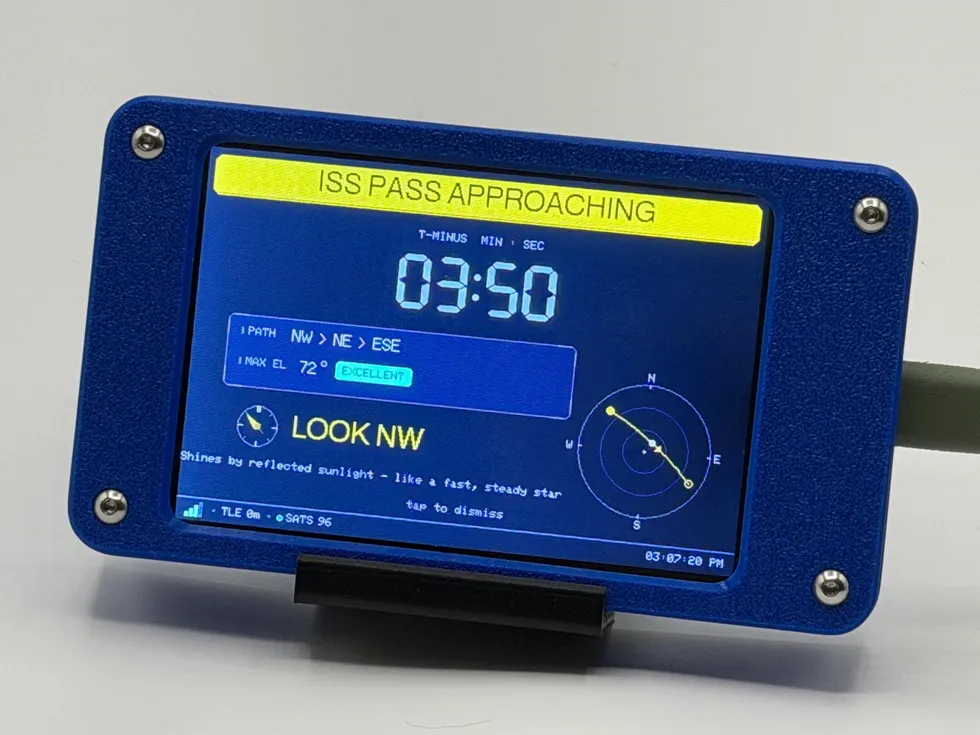
Satellite Sentinel also headlines the gift guide for space lovers & backyard astronomers, if you happen to be shopping for one.
MORE LAB NOTES
- How to Choose a Desktop Flight Tracker: 5 Questions to Ask
- Magnitude vs. Intensity: The Two Numbers Every Earthquake Gets
- What Is a Starlink Train? The String of Lights, Explained
- Weather Watch vs. Warning vs. Advisory: The Severity Ladder
- The Board Inside Every PlankLabs Gadget
- The Printers Behind the Shells: a Flashforge AD5X and a Bambu Lab X2D
- Arduino: The Workbench My Firmware Is Built On
- How the Outdoor Score Works: One Honest Number for “Should I Be Outside?”
- How to Read a Tide Chart (and Why Old Tide Clocks Drift)
- What Is ADS-B? How Flight Tracking Actually Works
- Is It Your WiFi or Your ISP? How to Tell in 60 Seconds