Weather Watch vs. Warning vs. Advisory: The Severity Ladder
A watch means a hazard is possible later, over a wide area. A warning means it is happening or about to, in a defined place. An advisory means conditions that are a nuisance and can still hurt you if you are careless. Most people have absorbed a vague sense that a warning is worse than a watch and no sense at all of where an advisory fits, which is why the single most common severe-weather mistake is not panic. It is a shrug at the wrong rung.
So here is the ladder, from the bottom up, with the part nobody tells you: what you are actually supposed to do at each level.
Advisory: this will be a nuisance, and it can hurt you if you are careless
An advisory covers conditions that are hazardous but not, by themselves, expected to threaten life. Wind Advisory. Heat Advisory. Winter Weather Advisory. Dense Fog Advisory. Frost Advisory. Small Craft Advisory.
The mental model is inconvenience with teeth. An advisory-level event will make something you had planned worse — a commute, a ballgame, a roof project, a trailer tow — and it is fully capable of causing real harm to someone who is exposed, unprepared, or already vulnerable. A Heat Advisory is a warm afternoon to a healthy thirty-year-old and a genuine medical event to someone in an un-air-conditioned apartment.
What to do: adjust the plan, don’t cancel it. Leave earlier for the slick roads. Move the outdoor work to the morning. Bring the plants in, put the umbrella down, check on the neighbor who is the reason this category exists at all.
One thing worth knowing: the Weather Service has been working for years toward replacing the word advisory with plain-language headlines, on the very reasonable grounds that “advisory” is bureaucratic noise that means nothing to a person reading it for the first time. If the word starts disappearing in favor of a sentence describing the actual hazard, that is the intent, not a glitch.
Watch: the ingredients are there
A watch means conditions are possible later. Not likely-in-your-yard, not happening — possible, over a broad area, within a window of several hours.
The kitchen analogy has survived this long because it is genuinely the right one: a watch is flour, eggs, and sugar sitting on the counter. Nobody has baked anything. Everything required is present.
Watches are the Weather Service’s forecasting product, and their shape tells you so. A Tornado Watch or Severe Thunderstorm Watch typically covers dozens of counties across multiple states and runs for six or eight hours, because the atmospheric setup that produces severe storms is regional. Above the watch sits an even earlier layer — the convective outlooks that categorize severe risk days in advance — and below it sits the warning.
What to do: this is the rung where preparation is cheap and later it will not be. Know where you would shelter. Charge the phone. Bring in what would become a projectile. Reconsider the three-hour drive, the boat, the hike into a canyon. Above all, stay reachable — the entire purpose of a watch is to buy you the lead time to be somewhere you can receive the warning.
Here is the part people find counterintuitive: a watch is issued while the sky above you may be completely, insultingly clear. That is normal. A Tornado Watch at two in the afternoon on a blue-sky day is exactly the product working as designed, because the storms it anticipates have not formed yet.
Warning: it is happening, and it is pointed at you
A warning means the hazard has been observed or is imminent, in a defined area, right now. Radar has detected rotation. A spotter has seen the tornado. The river gauge is rising past flood stage. The heat index has arrived.
Warnings look nothing like watches on a map, and that difference is the useful one. Modern severe warnings are drawn as storm-based polygons — irregular shapes covering the specific path of the specific storm, often just a few miles wide — rather than whole counties. If your address is inside the polygon, the alert is about you. If it is two counties away in the same watch, it is not.
What to do: act immediately and without negotiating with the sky. For a Tornado Warning, that means the lowest floor, the most interior room, away from windows, and something over your head. For a Flash Flood Warning, it means moving to higher ground and never driving into water. For a Severe Thunderstorm Warning, it means getting inside — the wind and hail criteria for that product are high enough to break windows and drop trees.
Warnings also carry an internal severity gradient that is easy to miss. Forecasters can tag the language of a warning to indicate an unusually dangerous situation, and the strongest tags — a tornado emergency, a flash flood emergency — are reserved for confirmed, catastrophic, ongoing events. If you ever see the word emergency inside a warning, that is the Weather Service dropping all professional reserve. Treat it accordingly.
The severity levels underneath the words
Alongside the familiar words, every alert carries a machine-readable severity level in the feed: Extreme, Severe, Moderate, or Minor. This is the scale that anything reading the data automatically — a phone, a site, a desk display — actually sorts on, and it is why two products with different names can land in the same tier.
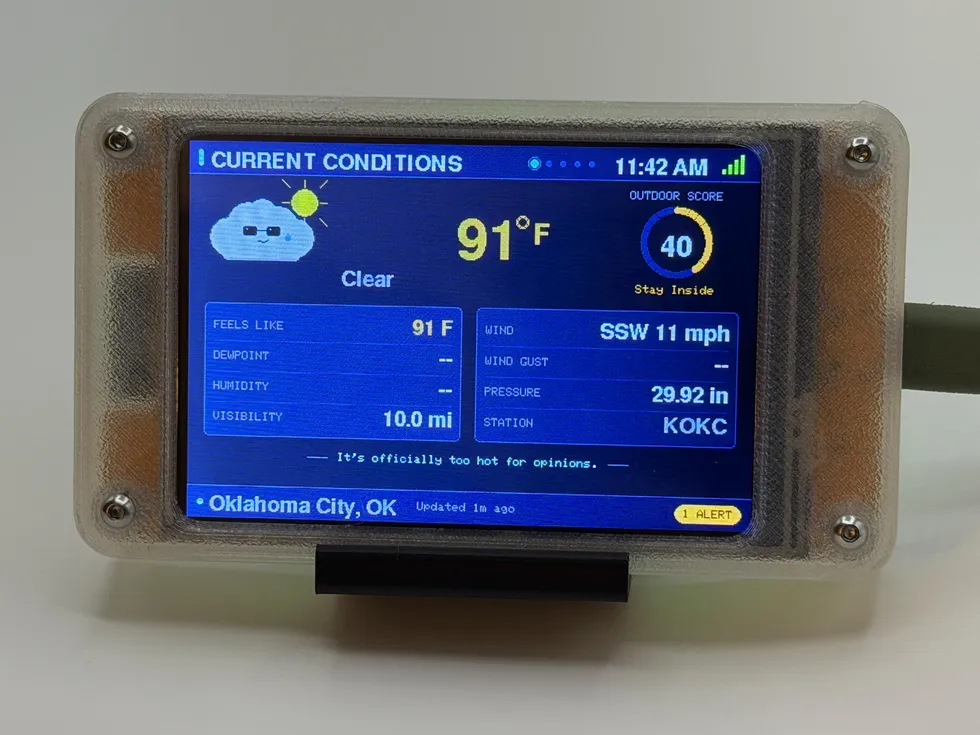
The Outdoor Score uses exactly that ladder. Active alerts carry the biggest penalties, scaled by severity: an Extreme alert costs 80 points, Severe costs 50, Moderate 25, Minor 10. And it applies the same distinction this whole note is about — watches are discounted, at half weight, because a watch means conditions are possible later; a warning means it’s happening. A Tornado Watch at 50% weight shouldn’t flatten a score the way a Tornado Warning at full weight absolutely should.
That is the mechanism behind a question people ask constantly: why is my score down when it is beautiful out? Because a watch for later is a real, official statement about the next several hours, and a number meant to answer “should I start something outside right now” cannot honestly ignore it. The window shows you the present. The watch is about four o’clock. Half weight is the compromise between the two, and it is why a clear sky under a Severe Thunderstorm Watch quietly loses points it looks like it deserves to keep.
Why the same weather generates four alerts at once
A single event routinely produces a pile of overlapping products. A Heat Advisory, an Extreme Heat Watch and an Extreme Heat Warning can all be live in adjacent areas of one heat wave, issued by different offices for different windows.
That is not disorganization. Each product has its own geography and its own valid time, and a forecaster in one office is describing a different afternoon than a forecaster two hundred miles away. When you are reading a list of alerts, the two questions that untangle it are always the same: where is it valid, and when is it valid? An impressive-looking stack of five alerts frequently resolves into one hazard, two counties, and three time windows.
The honest limits of any screen
A dedicated display is a good ambient awareness tool. It is not a safety device, and this is the paragraph where that gets said clearly rather than in fine print.
Anything that reads a public feed over home WiFi depends on your internet connection, your power, and your being in the room to see it. Severe weather is precisely the circumstance that takes all three away. A Wireless Emergency Alert reaches a phone in a basement at three in the morning; a screen on a desk upstairs does not. That is not a knock on screens — it is what the layers are for.
The setup that actually works has three parts. A NOAA Weather Radio with an alert tone is the one that wakes you up and does not care whether your router is fine. Wireless Emergency Alerts left switched on cover the short list of immediately life-threatening warnings. And official National Weather Service guidance — from weather.gov, your local forecast office, or a broadcast meteorologist relaying it — governs in an emergency, full stop, regardless of what any gadget is displaying.
Everything else, including anything built here, is context. Useful, genuinely — knowing at a glance that a watch is up changes how you plan an afternoon. But context is a different job from an alarm, and it is worth being honest about which one you are looking at.
Storm Sentinel, the desktop weather station I build, is context in exactly that sense: its Watches & Warnings screen lists the active alerts for your location. It is not safety equipment.
The whole ladder, in four lines
- Outlook — the risk exists, days out. Notice it.
- Advisory — hazardous but not life-threatening. Adjust the plan.
- Watch — the ingredients are there, possible later, over a wide area. Prepare and stay reachable.
- Warning — it is happening, here, now. Act immediately.
Learn those four and you have solved most of the problem, because the failure mode was never that people ignore warnings. It is that they hear “watch” and file it under “warning, but weaker,” when it is really a different kind of statement entirely — one about a few hours from now, made while the sun is still out, specifically so you have time to be somewhere you can hear the next one.
QUICK ANSWERS
Fair questions
What is the difference between a weather watch and a warning?
A watch means conditions are possible later; a warning means it’s happening. A watch is the Weather Service telling you the ingredients for a hazard have come together over a large area and a few hours; a warning is the Weather Service telling you the hazard has been detected, in a specific place, now.
What does a weather advisory mean?
A weather advisory means conditions are hazardous but not, by themselves, expected to threaten life: a slick commute, a gusty afternoon, dense fog, a hot day. Adjust the plan rather than cancel it, and take it seriously if you are exposed, unprepared or already vulnerable to that hazard.
Is an advisory something I can safely ignore?
Not ignore. Deprioritize. An advisory covers conditions that are genuinely inconvenient and can be dangerous if you are careless or exposed, but that are not expected to threaten life on their own: a slick commute, a gusty afternoon, dense fog, a hot day. Most advisories are answered by adjusting a plan rather than sheltering. The exception is anyone already vulnerable to that particular hazard, for whom a Heat Advisory or a Winter Weather Advisory is a real event.
Why does my phone scream for some alerts and stay silent for others?
Wireless Emergency Alerts are deliberately reserved for a short list of the most immediately life-threatening warnings: tornado, the most dangerous flash flooding, the most destructive thunderstorms, and a handful of others. Watches and advisories almost never trigger them, by design, because an alert that goes off constantly is an alert people turn off. It also means a silent phone is not evidence that nothing is happening.
Can I rely on a desk display for severe weather alerts?
No, and nothing on this site should ever be treated as safety equipment. A desk display polls a public feed over home WiFi, so it depends on your internet, your power, and being in the room. For anything life-safety, the layers that actually work are a NOAA Weather Radio with an alert tone, Wireless Emergency Alerts left switched on, and official National Weather Service guidance, which governs in an emergency regardless of what any gadget shows.
MORE LAB NOTES
- How to Choose a Desktop Flight Tracker: 5 Questions to Ask
- Magnitude vs. Intensity: The Two Numbers Every Earthquake Gets
- What Is a Starlink Train? The String of Lights, Explained
- The Board Inside Every PlankLabs Gadget
- The Printers Behind the Shells: a Flashforge AD5X and a Bambu Lab X2D
- Arduino: The Workbench My Firmware Is Built On
- How the Outdoor Score Works: One Honest Number for “Should I Be Outside?”
- How to Read a Tide Chart (and Why Old Tide Clocks Drift)
- What Is ADS-B? How Flight Tracking Actually Works
- When Can You Actually See the ISS? Visibility Windows, Explained
- Is It Your WiFi or Your ISP? How to Tell in 60 Seconds